Reading an Expanded Metal Ceiling: Open Area Sets the Pattern
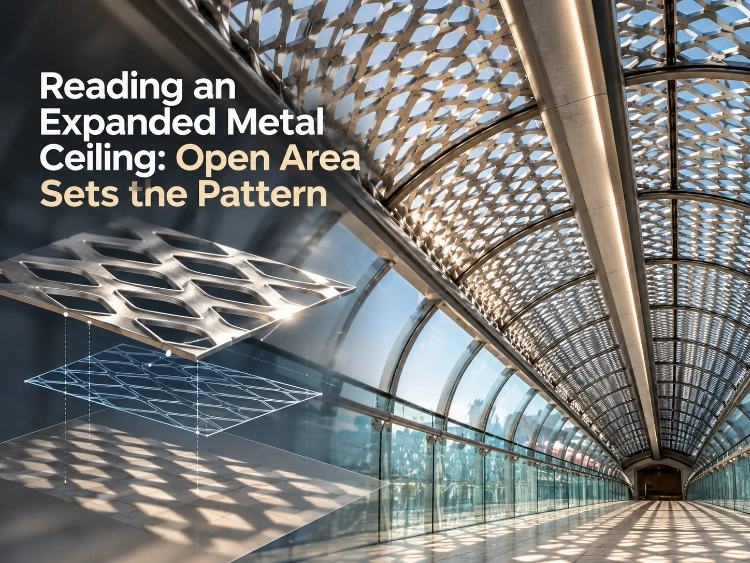
Stand under an expanded ceiling and the pattern is the first thing you read. The open area is the second, once light and the structure above show through the mesh. Both come from one drawing decision, fixed before the sheets are expanded. Pattern, strand and flatten can't be changed later the way a paint colour can.
Open area sets how much of the space above stays visible. Strand width and pitch set how heavy the pattern reads from below. Long-way and short-way openings carry the rhythm of the diamond. Raw thickness and flatten decide how a panel sits, spans and handles. Change one once the coil is expanded and that sheet is remade.
Same pitch, different strand: 2 mm reads light, 5 mm reads solid. That's why we want the figure in hand before quoting a pattern.
Expanded is one of five families under metal ceiling systems, next to tile, baffle, strip and open cell.
Open Area and the Pattern It Buys
How much of the plenum you want to show
How much of the sheet stays open is the open-area figure, and it comes first. Push it high and the plenum reads through the mesh: your ceiling works like a screen you can see past. Pull it low and the face closes up until pattern is all you look at. Same geometry sits anywhere between those two, which is why the figure belongs to the room and not to a catalogue page.
The number does more than looks. Light reaching the floor. Air moving into the plenum. How much structure above stays in view. A lobby usually wants openness. A plantroom ceiling usually wants cover. We take the figure from the room first, then let it fix pattern size. A flat mesh sample tells you almost nothing about how it reads from 6 m below.
Open area and pattern are one decision, not two. Fix the percentage first. Then pick the pattern that delivers it at the aperture your room can take.
Strand width against pitch
Strand is the metal left between openings. Width against pitch decides whether a panel feels solid or light. Thin strand on wide pitch reads airy from the floor. Thick strand on tight pitch reads heavy, nearly closed. Two different strand widths can reach one open-area figure, and they look nothing alike once hung.
Long way, short way and the diamond
Diamond is what most expanded ceilings use. Decorative patterns come in when a design wants something finer or more directional. Opening size sets character. A large aperture reads bold and open. A small one reads dense, closer to solid. Flattening moves the sightline again. Raised strands stand out, catch light on their edges and break the view of everything above. A flattened sheet lies in one plane and hides nothing.
Expanded mesh carries a direction too. Long way and short way order openings differently, and they don't have to match. Let them differ and the diamond stretches longer. That's a design decision, not a fault, so fix it before the coil is expanded.
Separate cells define an open cell ceiling; expanded metal reads as one continuous mesh. Both are open geometries, and the difference shows from an angle rather than from straight below.
Flattening and Panel Behaviour
Flattened or raised
Flattening is the one people miss. Flattened sheet lies flat and gives a direct view of whatever sits above, which suits a services zone that's been dressed properly. Left raised, the strands stand up, cut the sightline and hide the substructure. Send one and order the other and you can't correct it on site. Sheet gets expanded again. Coating normally runs after expansion, which is why a late finish change is more than a colour swap.
Panels that lift or swing
Open mesh gets chosen so people can look up through it. Same openness makes service easy. Panels can be set to lift, swing or slide, so a duct, valve or damper above can be reached without opening a whole ceiling.
That operability has to be drawn. Name the panel that lifts and its position on the sheet. Line it up with the service it reaches. Decide what happens to pattern when that panel swings. A cut panel in an otherwise uniform mesh is visible from straight below, so it goes on the same module as the rest.

Fixtures and the Cutting List
Light through the openings
Light passes through open area, so fixture positions and mesh pattern belong on one sheet. A downlight set into an opening reads as intended. A fitting over a strand reads as a break. Sprinklers and diffusers behave the same. Where sound control is part of the target, a panel can take an acoustic backing, and that backing adds weight. Recalculate suspension spacing with it, not after it.
Where the cutting list gets set
Nothing gets stretched until eight items sit on one sheet: open area, pattern, strand width and pitch, long-way and short-way openings, thickness, flatten state and any acoustic backing. Those eight are what we price and what the cutting list is built from. Our pattern and design verification checks the mesh against them.
Conclusion
An expanded ceiling is specified by geometry and chosen for an effect. Open area, pattern, strand, thickness, flatten state, access and lighting all move the same ceiling, and most of them can't be adjusted once the sheet is expanded.
A cut list needs the target open area, the strand and thickness intent, the access points and any acoustic requirement; send those with your reflected ceiling plan to TUODELI, and we'll check the mesh against the room before the coil is cut.
FAQs
Q1: What decides whether the plenum shows through the mesh?
A1: Open area does, and the pattern carries it. A more open sheet lets the structure above read through, which suits a lobby. A tighter pattern closes the face and lets the pattern work. The room sets the figure, and the figure sets the pattern size.
Q2: How do you plan access through an expanded ceiling?
A2: Name the panel that lifts on the drawing and line it up with the service it reaches. Panels can be set to lift, swing or slide, and each operable panel has to be matched to the duct, valve or damper above it.
Q3: Why does the same open area look different on two patterns?
A3: Because strand width and pitch set how heavy the face reads. A thin strand on a wide pitch reads airy from the floor, while a thick strand on the same open-area figure reads heavy and nearly closed. Long-way and short-way openings stretch the diamond as well.
Other News