Powder Coating vs Anodizing for Aluminum Ceilings
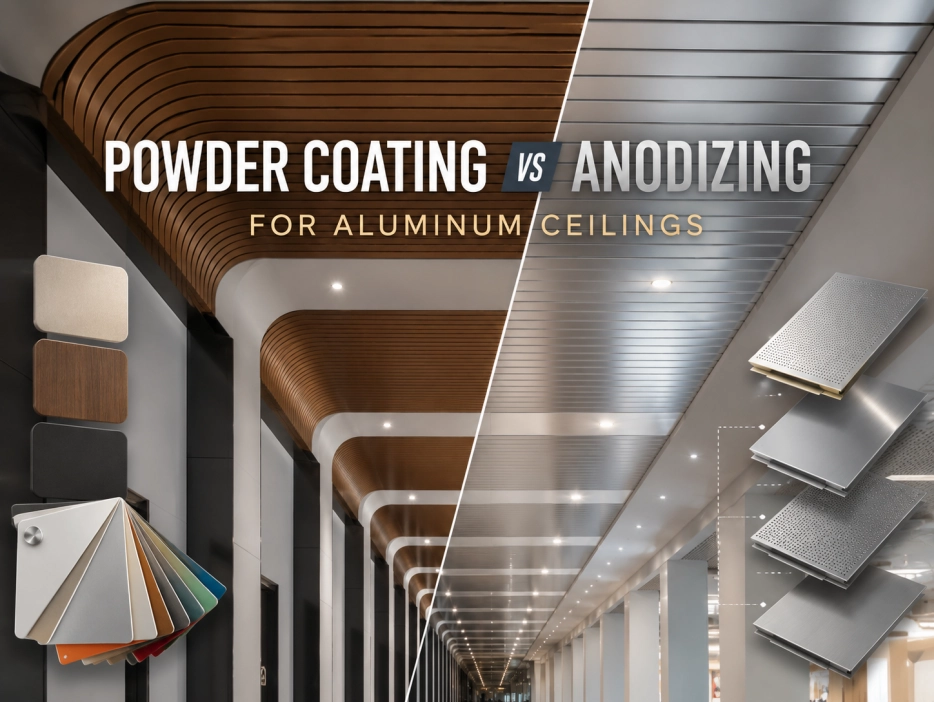
Powder coating vs anodizing is often presented as a simple durability contest. That approach misses an important point when the finished product is an aluminum ceiling.
A ceiling is a large, highly visible surface. Artificial light travels across it. Panels sit edge to edge. Some modules are removed during maintenance. Perforations create thousands of small edges, while curved or folded panels interact with light differently from flat samples. For that reason, choosing an aluminum surface finish should start with the installed ceiling—not with a generic statement about which finish is “better.” Powder coated aluminum gives designers broad control over color and surface appearance. An anodized aluminum finish retains more of aluminum's metallic character. Both can be useful architectural aluminum finishes when their appearance, fabrication sequence and project environment match the design.
What Is the Actual Difference Between Powder Coating and Anodizing?
The two processes create their finishes in fundamentally different ways.
How Is Powder Coated Aluminum Produced?
Powder coating is a dry finishing process. Finely ground coating particles are electrostatically applied to the prepared metal and then cured to form a uniform film.
For ceilings, the attraction is design flexibility. Powder coated aluminum can support a broad architectural color palette and can be coordinated with other visible ceiling components.
The finish should be reviewed together with substrate preparation, formed edges and required gloss or texture because those details influence the final visual result.
What Happens During Anodizing?
Anodizing is an electrochemical process that modifies the aluminum surface and creates an oxide layer integral with the metal.
An anodized aluminum finish is therefore visually different from an opaque painted film. It can retain the metallic qualities designers often want when aluminum itself is part of the aesthetic.
TUODELI lists anodizing alongside powder coating, spray paint and roller coating on several aluminum ceiling products. Buyers comparing powder coating vs anodizing therefore have more than a theoretical choice; the finish can be coordinated with the selected ceiling product and project appearance.
Which Finish Gives Designers More Visual Control?
Color selection is only the first layer of the decision.
When Does Powder Coating Fit the Design Better?
Powder coated aluminum is useful when a project requires a defined architectural color, a coordinated palette or a ceiling that visually connects with other interior elements.
RAL-based selection can provide a starting reference, but a physical sample remains important. Gloss, texture, substrate and lighting can all change how a color appears once the ceiling is installed.
This becomes more important over large areas, where multiple panels are seen together rather than one sample being viewed alone.
When Does an Anodized Finish Make More Sense?
An anodized aluminum finish works particularly well when the designer wants the surface to read as metal rather than as a painted color plane.
Silver, bronze and darker metallic appearances can interact strongly with grazing light and architectural geometry. In a ceiling, this can create depth without adding a separate graphic pattern.
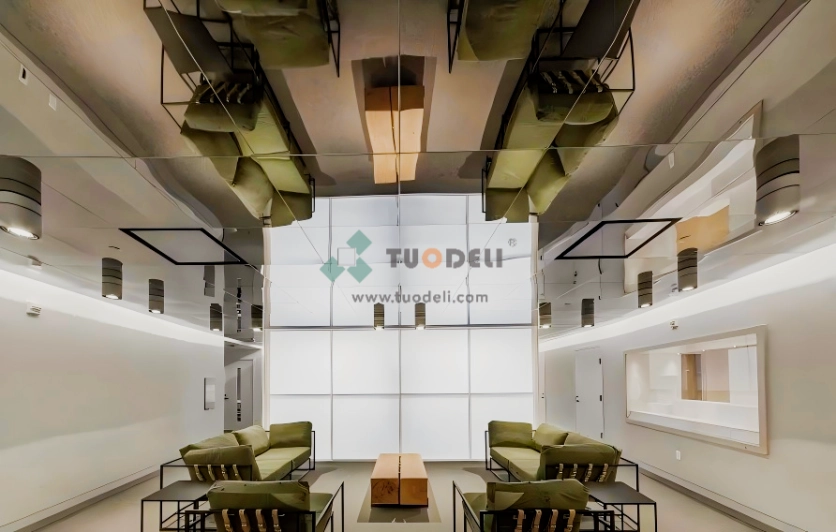
TUODELI's Metal Mirror Tile Ceiling demonstrates how reflective metal appearance can become a major part of the ceiling concept, although mirror-type finishes and anodized finishes are separate finish approaches.
Why Should Samples Be Viewed Under Project Lighting?

A ceiling sample on a desk is illuminated differently from a panel suspended several meters above the floor.
Linear lights, spotlights and daylight can emphasize texture, gloss and small variations. A curved panel may also reflect the environment differently across its surface.
For custom work, the ceiling sample approval guide is useful because sample approval can include material, finish, color, perforation, geometry and the real lighting context rather than relying only on a color code.
How Do Perforation and Forming Affect the Finish Decision?
A flat sample does not show everything that will happen on the finished panel.
What Changes Around Perforated Areas?
Perforated panels contain many exposed hole edges and a large number of repeated visual details. The perforation pattern can create shadows that alter the apparent color and brightness of the face.
The finish specification should therefore be coordinated with perforation size, spacing and panel border.
For acoustic ceilings, the dark acoustic tissue or infill behind the perforation can also change the visual contrast. A light-colored perforated face with dark backing will read differently from a solid panel in the same nominal color.
Why Do Folded Edges Matter?
Most ceiling panels need formed returns, clips or edges to engage the suspension system.
Those areas experience forming and, later, handling during installation and maintenance. The selected finishing process should therefore suit the production sequence and panel geometry.
Rather than approve only a flat color coupon, a project team can approve a representative formed panel. That makes joint appearance, edge condition and surface character visible before mass production.
What About Baffles and Curved Components?
Long baffles and curved ceiling elements create different reflections from flat tiles. Their sides may be visible as well as their lower faces.
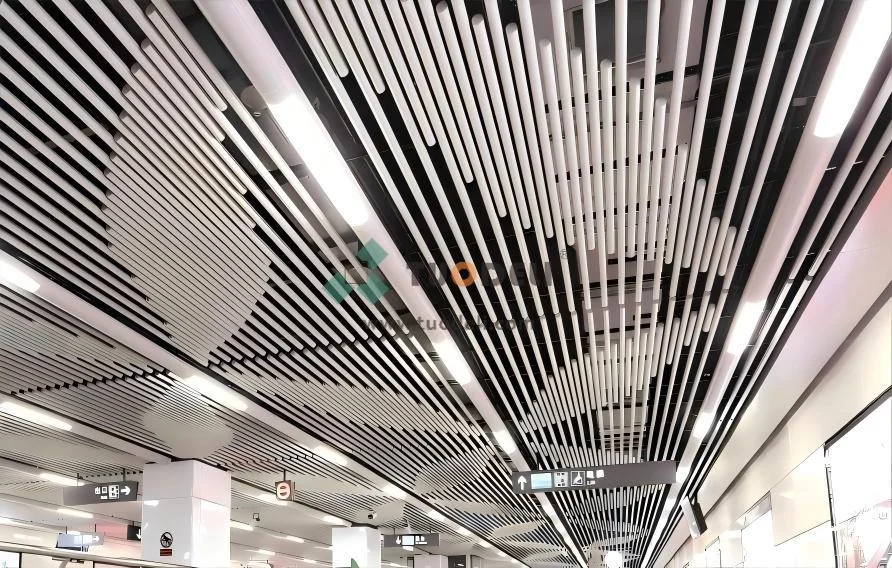
TUODELI's Aluminum U-shape Baffle Ceiling lists powder coating, spray paint, roller coating, anodized finishes and decorative wood- or stone-look options. That range allows finish selection to be considered together with the geometry rather than after the profile has already been fixed.
Which Aluminum Surface Finish Works Better in Daily Use?
Maintenance is another area where generic finish comparisons can oversimplify the decision.
How Will the Ceiling Be Cleaned?
Metal ceilings require relatively little routine maintenance, but cleaning methods still need to suit the finish.
Different surfaces can react differently to cleaning agents, especially in gloss and appearance. A practical maintenance plan uses cleaning methods compatible with the approved coating or anodized surface.
This is particularly important in healthcare, transportation, retail and food-related environments where cleaning frequency may be higher.
Will Panels Be Removed Frequently?
A service-heavy ceiling may be opened repeatedly to reach equipment above it. That means installers and maintenance staff interact with panel edges more often.
Finish selection should therefore be discussed with the access strategy. A representative panel can be used to assess appearance around corners and formed edges before the project enters full production.
This is one reason powder coating vs anodizing cannot be separated from the ceiling system itself.
How Should Buyers Compare Architectural Aluminum Finishes?
A useful finish comparison should include measurable project requirements and visual approval.
Start With the Desired Appearance
First decide whether the ceiling should read as a colored architectural plane, a metallic surface, a reflective feature or a decorative texture.
That narrows the choice of architectural aluminum finishes much more effectively than starting with a long list of coating technologies.
Match the Finish Across Connected Components
Panel faces are only part of the visible system. Perimeter trims, baffles, suspension components and other accessories may appear in the same field of view.
When those parts are intended to match, finish coordination should be specified early. A consistent aluminum surface finish across related components makes transitions less distracting.
Approve the Right Sample
The most useful sample represents the actual substrate, geometry and finish. For perforated products, it should include the relevant perforation. For curved products, it should show the curvature or a representative formed section.
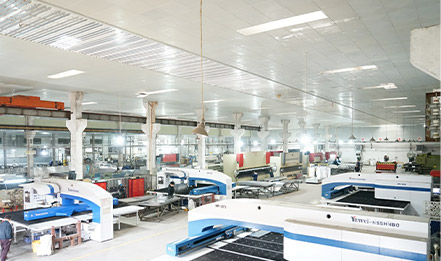
TUODELI performs inspection before and after coating as part of its production quality workflow and also includes pattern and design verification. This supports a project process in which approved finish requirements can be carried into production.
What Should Go Into the Finish Specification?
For powder coated aluminum, define the color reference, target appearance, gloss or texture and approved sample. Where project conditions require additional coating performance, include those requirements in the technical specification.
For an anodized aluminum finish, define the required anodized appearance and approve a representative sample using the actual aluminum substrate.
For both architectural aluminum finishes, add the panel material, geometry, perforation and maintenance conditions. This gives the manufacturer a complete target instead of an isolated finish name.
TUODELI has more than 30 years of experience with architectural metal ceiling systems and offers multiple finishes across its ceiling range. Buyers with custom colors, metallic effects or mixed ceiling geometries can explore TUODELI architectural metal systems and coordinate the finish together with the product configuration.
Conclusion
Powder coating vs anodizing should be decided by what the finished ceiling needs to look like and how it will be used.
Powder coated aluminum offers strong color and surface-design flexibility. An anodized aluminum finish preserves the metallic character of aluminum and can create a distinct architectural effect. Neither decision should stop at a small flat sample.
Look at the full panel. Check perforations and formed edges. View it under representative lighting. Coordinate trims and adjoining components. Consider maintenance access. Then approve the aluminum surface finish that supports the actual ceiling concept.
That process turns architectural aluminum finishes from a catalog option into a controlled design decision.
FAQs
Q1: Is powder coated aluminum suitable for decorative ceilings?
A1: Yes. Powder coated aluminum is widely suited to ceiling designs that require controlled architectural colors, textures and coordinated components. The final color and gloss should be approved on a representative substrate and panel geometry.
Q2: What is the main visual advantage of an anodized aluminum finish?
A2: An anodized aluminum finish retains more of the natural metallic character of aluminum because the anodized layer is formed through an electrochemical surface process. This makes it attractive where the designer wants the ceiling to read clearly as metal.
Q3: Which aluminum surface finish is best for perforated ceiling panels?
A3: The choice depends on the desired color, metallic appearance, panel geometry and project conditions. For perforated panels, evaluate the aluminum surface finish together with hole pattern, backing color, formed borders and actual lighting before approving the final specification.
Other News