How Are Metal Ceiling Tiles Made? From Coil to Finished Panel
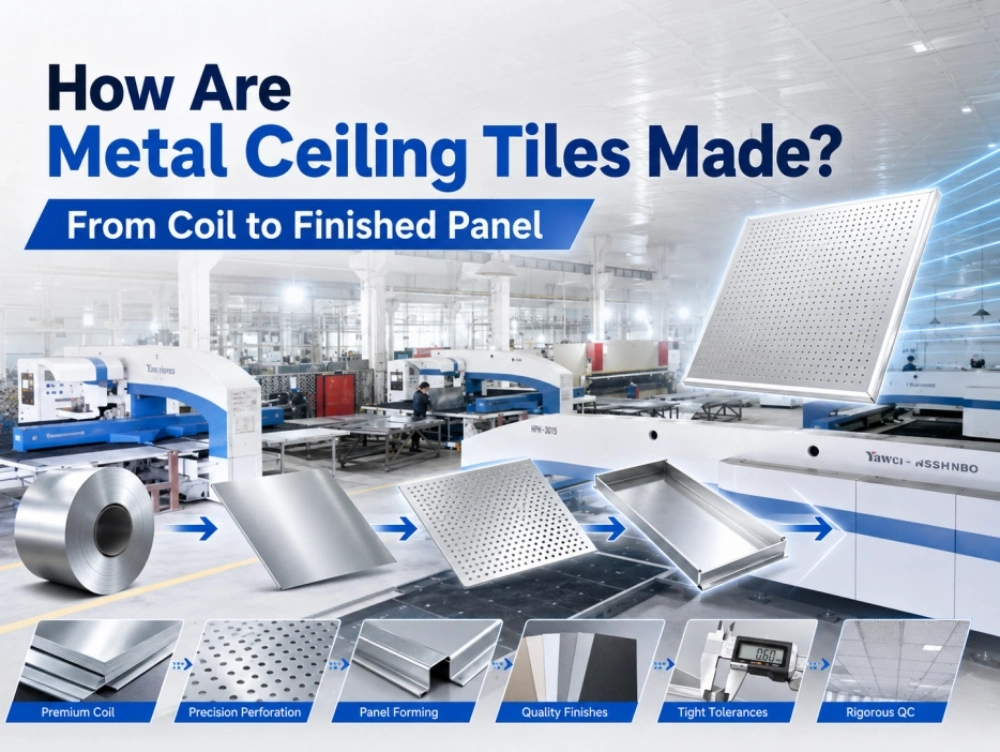
A finished metal ceiling tile looks simple: a flat panel, clean edges, a uniform finish and perhaps thousands of small perforations. Yet many of the problems that become obvious after installation—uneven joints, visible ripples, inconsistent color or panels that do not sit cleanly in the suspension system—can be traced much further upstream.
So, how are metal ceiling tiles made when the goal is not merely to produce a panel, but to produce hundreds or thousands of panels that behave as one ceiling? A well-controlled metal ceiling manufacturing process connects material selection, leveling, perforation, forming, finishing and inspection. Each stage affects what architects, contractors and building owners eventually see overhead. For buyers evaluating aluminum ceiling tile production, knowing these relationships is more useful than simply seeing a list of factory machines.
What Happens Between the Metal Coil and the Finished Ceiling Tile?
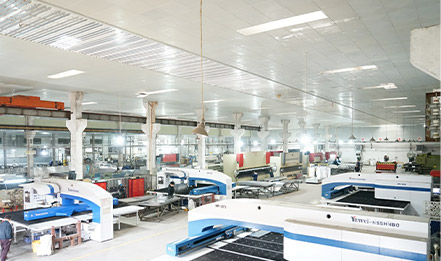
A metal ceiling production line converts sheet or coil into a precisely formed architectural component. The key point is consistency. One attractive sample is useful, but a commercial ceiling normally needs repeatable dimensions, edges, color and surface quality across a much larger area.
Why Does Incoming Material Matter Before Cutting Begins?
Aluminum, galvanized steel and stainless steel can all be used for metal ceiling systems. The material and thickness need to match the required panel format, forming geometry, finish and application.
Before production moves forward, the incoming material should be checked against the specification. TUODELI's production quality sequence includes Incoming Raw Material Inspection before subsequent perforation, forming and coating checks. Buyers can review the broader TUODELI production and quality process when preparing project documentation.
This first step matters because dimensional consistency begins with the substrate. Coil condition, sheet flatness and material thickness all influence later forming.
What Changes When a Panel Is Perforated?
Perforation is not just a decorative operation. It removes material from the sheet, changes its visual appearance and creates the path through which sound can reach acoustic material behind the panel.
In perforated metal ceiling manufacturing, hole diameter, spacing, arrangement and the unperforated border all need to match the design. Round, square, rectangular, linear, diagonal and staggered patterns can create very different visual effects.
A solid border around a perforated field is also useful around formed edges. It gives the panel edge enough uninterrupted material for controlled bending and joint formation.
Why Is Edge Forming So Important?
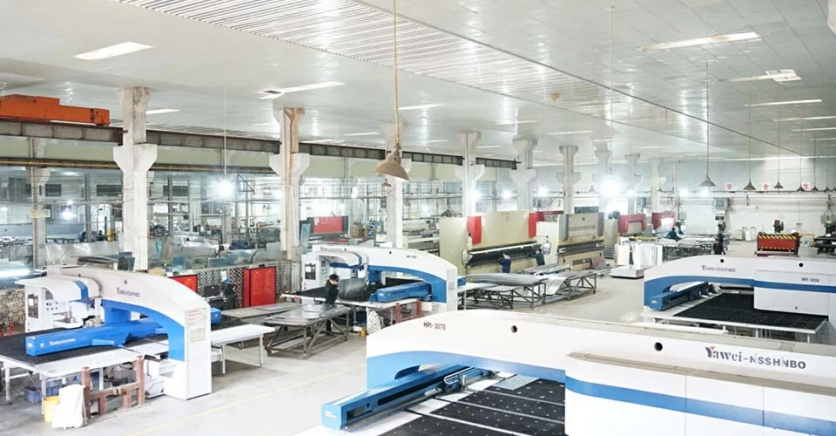
A ceiling panel is not simply cut to width and installed. Its edges determine how it interfaces with the suspension system.
Clip-in, lay-in and hook-on products use different edge conditions and support methods. Forming therefore controls more than appearance: it influences joint alignment, panel retention, accessibility and how easily a ceiling can be serviced later.
For example, TUODELI's Aluminum Triangle Tile Ceiling is offered as a clip-in tile system, demonstrating how panel geometry and suspension strategy work together rather than being separate purchasing decisions.
Why Does Production Control Matter More Than Production Speed?
Fast output can be useful on a large project, but repeatable output is what protects the finished ceiling. A strong aluminum ceiling tile production plan therefore controls flatness, dimensions and finish throughout the run.
How Does Leveling Affect What You See From the Floor?
Sheet metal can retain stresses from coiling, punching and forming. On a large reflective ceiling, relatively small surface deviations can become visible when light travels across the panel.
Typical visible conditions in architectural metalwork include oil canning or rippling, bowing, twisting, stepping between adjacent edges and inconsistent gaps. These are important because ceiling lighting often makes surface variation easier to see.
Leveling and dimensional control should therefore be treated as part of the metal ceiling manufacturing process, rather than as a cosmetic check at the end.
Why Do Millimeters Matter at Panel Joints?
A single panel can be slightly out of dimension and still look acceptable on a workbench. Repeat that difference across a long corridor, airport terminal or office floor and joint lines can begin to drift.
This is why perforation dimensions and shaping dimensions should be checked independently. TUODELI includes both Perforation Dimensional Inspection and Shaping Dimensional Inspection in its process control.
For buyers, the useful question is not only “What size panel can you make?” It is also “How will panel dimensions, edge geometry and suspension layout remain coordinated through the production batch?”
When Should the Finish Be Controlled?
Metal ceiling finishes can include powder coating, spray paint, roller coating, anodizing and decorative wood- or stone-look surfaces, depending on product and design.
Finish control is especially important on ceilings because panels are viewed together across a broad plane. Slight differences in gloss, texture or tone can become more apparent when continuous lighting crosses several modules.
TUODELI therefore separates Before Coating Surface Inspection and After Coating Surface Inspection within its quality sequence. That creates an opportunity to catch substrate or surface issues before final packing.
How Does Perforated Metal Ceiling Manufacturing Affect Acoustics?
Perforation is often discussed as though the holes alone create an acoustic ceiling. The actual system is more interesting.
What Happens to Sound After It Passes Through the Holes?
A perforated metal face allows sound energy to pass through the visible panel. Acoustic tissue or absorptive material behind the panel can then contribute to sound absorption.
TUODELI's broader metal tile ceiling range includes perforated configurations with acoustic backing options. The tile category identifies SOUNDTEX acoustic tissue and glass fiber wool as available approaches, while specific tile products provide their own acoustic performance ranges.
This is why perforated metal ceiling manufacturing should coordinate the visible perforation with the backing configuration rather than treating the two as unrelated components.
Does More Open Area Automatically Mean Better Performance?
Not by itself. Hole size, spacing, percentage of open area, backing material and the system behind the panel all contribute to the acoustic result.
The pattern also has structural and visual consequences. A dense perforation field changes the amount of solid metal remaining in the panel, while a sparse pattern produces a different appearance and acoustic pathway.
A buyer should therefore specify the perforation pattern and acoustic requirement together. Doing so is much more useful than ordering “perforated panels” without defining the expected system.
Which Quality Checks Matter Before a Ceiling Leaves the Factory?
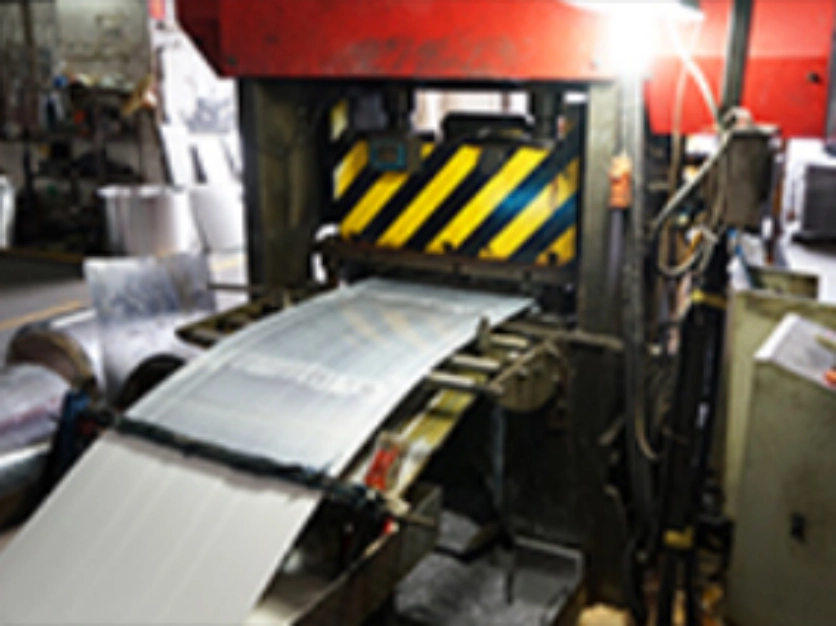
Good inspection is not one final glance at a packed panel. It follows the product through the metal ceiling production line.
Which Dimensions Should Be Confirmed?
Incoming material, perforation dimensions and formed dimensions should all match the approved specification. For custom modules, drawings become particularly important because panel size alone does not describe edge returns, joint conditions or service openings.
Random measurement during production helps identify drift before it spreads across a larger batch.
How Should Surface and Pattern Consistency Be Checked?
For colored or patterned ceilings, color alone is not enough. Gloss, texture, orientation and the way the finish reacts to light can change the perception of the ceiling.
TUODELI includes Pattern and Design Verification as well as inspection before and after coating. For custom projects, an approved physical sample can therefore function as a practical reference for later production comparison.
Why Does Final Inspection Still Matter?
Random sampling, final inspection and controlled rework provide the last opportunity to check that production matches the approved requirement before shipment.
Packing should also protect visible faces, corners and formed edges. An undamaged surface with clean edge geometry saves work at the installation stage, especially on ceilings where individual panels sit immediately beside one another.
What Should Buyers Put in an RFQ Before Production Starts?
A useful RFQ gives the manufacturer enough information to build the correct system rather than merely quote a square-meter price.
Which Panel and Suspension Details Are Essential?
Define the product type, panel dimensions, material, thickness, edge configuration and suspension method. If lighting, sprinklers, speakers, diffusers or access panels interrupt the ceiling, show their locations on the reflected ceiling plan.
For large custom areas, provide module drawings and critical transitions early. This helps the manufacturer coordinate forming and installation details before material enters production.
Which Surface and Acoustic Details Should Be Fixed?
State the finish type, color reference, required gloss or texture, perforation pattern and acoustic backing. If visual appearance is critical, approve a representative sample under lighting similar to the project environment.
For perforated ceilings, include both the visual perforation requirement and the acoustic target.
What Should Be Confirmed Before Shipment?
Confirm quantity by module, spare-panel requirements, packaging marks and destination information. Custom-shaped or differently sized panels should be identifiable during installation.
TUODELI has more than 30 years of experience in architectural metal ceiling and wall systems and supports custom design and project solutions. Buyers ready to move from concept to production can send a ceiling specification for a quote so panel type, finish, acoustics and project quantities can be reviewed together.
Conclusion
The useful answer to “how are metal ceiling tiles made” goes far beyond cutting and coating sheet metal. A dependable result comes from connecting incoming material, perforation, leveling, forming, finish control, acoustic configuration and inspection.
The best metal ceiling manufacturing process is one in which each production decision has a clear relationship with the installed ceiling. Flatness affects reflected light. Edge geometry affects alignment and access. Perforation affects both appearance and acoustic design. Finish consistency affects the way hundreds of modules read as a single architectural surface.
For buyers, that makes the factory process a practical specification tool. Define the finished performance first, then make sure the aluminum ceiling tile production and inspection plan can reproduce it throughout the project.
FAQs
Q1: How are metal ceiling tiles made for large commercial projects?
A1: Metal sheet or coil moves through material inspection, cutting or punching, perforation where required, leveling, forming, surface finishing and dimensional inspection before packing. The exact sequence changes with the panel geometry and finish, but the goal is consistent modules that fit the selected suspension system.
Q2: What should buyers check in a metal ceiling production line?
A2: Look at how the manufacturer controls raw material, flatness, perforation dimensions, formed edges, coating quality, pattern consistency and final inspection. A metal ceiling production line should support repeatability across the full project quantity, not only a successful first sample.
Q3: Why is perforated metal ceiling manufacturing more than punching holes?
A3: Perforated metal ceiling manufacturing must coordinate hole pattern, solid borders, forming, surface finish and acoustic backing. These choices affect appearance, panel stability, edge quality and the way the completed ceiling absorbs sound.
Other News