Why Powder Coating Quality Matters for Aluminum Ceiling Panels
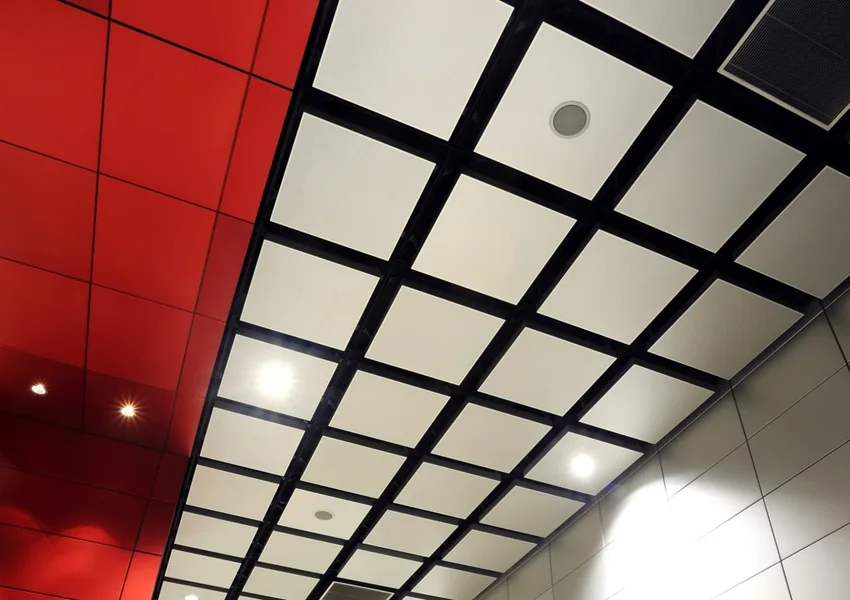
A ceiling finish is easy to judge on the first day. It is much harder to judge after a few humid summers, repeated cleaning, lighting changes, and the small dents that happen during maintenance access. That is why powder-coated aluminum panels deserve more attention than a quick color approval. For airports, stations, shopping centers, schools, offices, and exterior soffits, the coating is not just decoration. It affects color consistency, corrosion resistance, gloss retention, and how well the full ceiling package still looks after installation.
Many project teams compare panel type, perforation pattern, and price first. Those points matter, but the aluminum ceiling coating can quietly decide whether the ceiling feels premium or uneven. A strong specification should look at the formed panel, trims, suspension, accessories, cleaning needs, and exposure conditions together.
Powder Coating is Different From Coil Coating
Metal ceilings can be finished in several ways, including coil coating, baked enamel, powder coating, and anodizing. Powder coating is usually applied after the aluminum has already been formed into a ceiling component. Fine, dry particles are charged and sprayed onto grounded metal parts, then cured in an oven to form a continuous film. That sequence is important. The coating covers the finished shape, including edges, bends, and formed details that may be more exposed in use.
Pre-painted coil coating follows another path. The aluminum coil is cleaned, treated, primed, coated, cured, inspected, and rewound before it becomes panels or profiles. Coil coating can be efficient for standard flat products, while powder-coated aluminum panels are often useful when the project has formed parts, custom geometry, trims, baffles, or accessories that need a finished surface after fabrication.
The choice is not only about which process sounds more advanced. A buyer should ask what the ceiling component actually is, where the edges sit, whether the product will be curved or perforated, and how much finish matching is needed across the package. When the job includes aluminum tile ceilings, perimeter trims, lighting openings, and access panels, the coating route can affect both appearance and site handling.
Why Powder Coating Quality Shows up on the Installed Ceiling
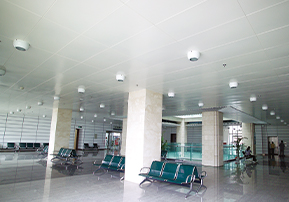
Powder coating quality tends to reveal itself in small differences. One panel may look slightly dull beside another. A trim may not match the panel face under strong lobby lighting. A curved part may show thin coverage near a bend. In a retail corridor or transport terminal, these small differences are not small for the client. The ceiling sits in a wide field of view, so uneven gloss and color changes can be seen from a distance.
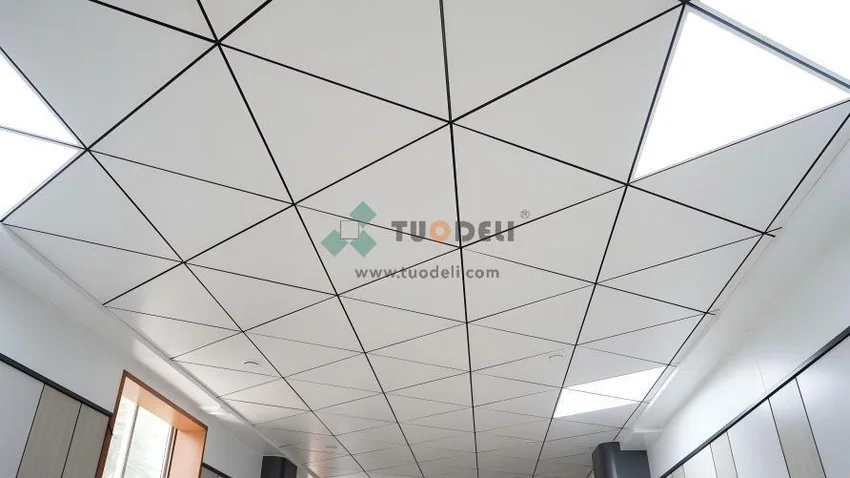
Good finish control also matters because ceiling systems are rarely made from one visible item. Panels, planks, baffles, suspension faces, perimeter trims, and accessories may all sit next to each other. In custom work, the risk grows because curved panels, special trims, and graphic perforations increase cost and lead time. If the finish does not match, replacing one part can delay the whole handover.
The practical check is simple: do not approve powder-coated aluminum panels by one small swatch alone. Ask for sample pieces that represent the real profile, edge, thickness, and perforation. If the ceiling includes an aluminum triangle tile ceiling or formed baffle parts, the sample should show the formed detail, not only a flat coupon. A sample is not paperwork. It is a way to see how the aluminum ceiling coating behaves on the actual product.
Outdoor and Humid Spaces Need a Stricter Finish Conversation
In contrast to indoor office panels, exterior aluminum panels for soffits, station entrances, covered walkways, etc. are exposed to wind-driven rain, salt air, high humidity, solar exposure, and extreme temperature fluctuations. Additionally, they are subjected to much harsher light than interior applications, and consequently, even the smallest color change is very visible. As aluminum panels are inherently resistant to corrosion, the coating is only of relevance and must provide adequate protection of the surface, retain color, and resist premature chalking or gloss loss.
For exterior ceilings, finish quality should sit beside wind load and fixing details in the review. Industry practice often asks for positive and negative wind load data for exterior soffits or entrances because panels face both upward and downward pressure. The coating conversation is similar. Buyers should ask how the finish is applied, cured, checked, packed, and handled before shipment. Good powder coating quality is part of durability, but it cannot rescue a ceiling system that is poorly supported or badly installed.
Another aspect of finishes is the role that they play in humid interior environments such as hospitals, kitchens, laboratories, restrooms in transit facilities, and semi-public commercial areas like retail stores, restaurants, and office spaces. Because metal ceiling systems are nonporous and do not absorb water like most soft panels, aluminum ceiling systems can be a very durable and moisture-resistant finish. However, any finish can be subject to degradation from moisture and cleaning products over time, and it is best to investigate the ceiling panel supplier’s knowledge of the limits of cleaning, surface repair, and replacement matching. Such investigation is particularly important for public spaces where the ceiling system will likely be in service for many years.
Finish Matching Across Custom Ceiling Parts
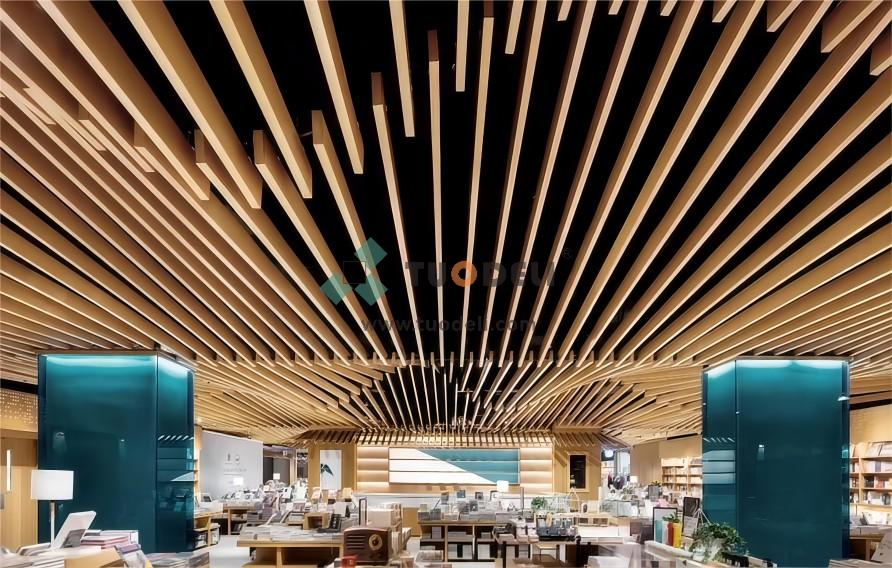
Custom ceilings are where finish control becomes more demanding. A ceiling may combine flat panels, baffles, curved trims, plenum masks, perforated sections, and access zones. The design team may want a metallic tone, simulated wood grain, matte white, or a strong brand color. Once several components meet in one view, color difference becomes easier to notice.
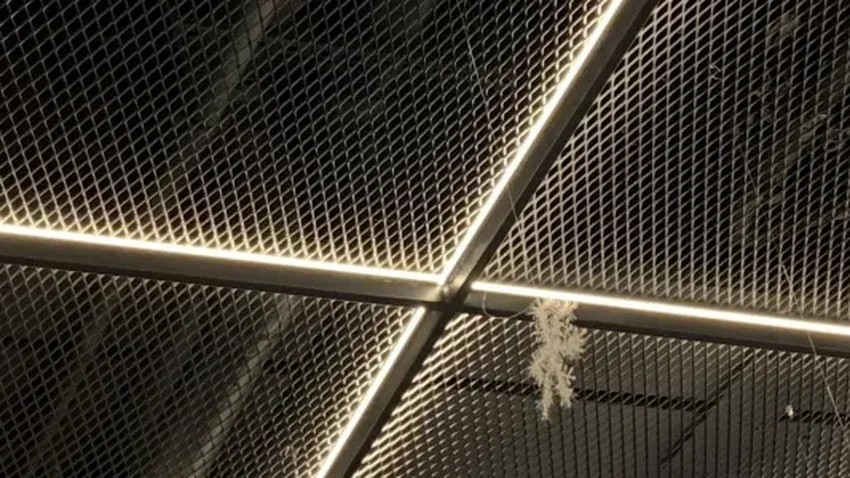
A single-source approach can reduce that risk. When panels, suspension, trims, and accessories are coordinated by one ceiling panel supplier, the project team has fewer finish batches to reconcile. That does not remove the need for approval samples, but it makes responsibility clearer. TUODELI's range includes custom baffle ceiling solutions as well as tiles and special ceilings, which can help when finish matching must cover more than one product family.
Perforations add another detail. A perforated ceiling will contribute to acoustic absorption if the perforations are penetrated by backing material such as fabric or fibrous batting. The perforations also increase the exposed edge of the ceiling liner and the texture of the visual finish. The finish of perforated powder-coated aluminum panels requires regular cleaning and curing and special packaging. For projects with custom logos, such as a company’s identity, graduated perforations, or a variety of panel sizes, it is best to check both finish and fabrication drawings before entering mass production.
Procurement Checks that Prevent Finish Disputes
A strong procurement check does not need to be complicated. It needs to be specific. Before placing the order, ask the supplier to provide samples of real panels and not just color samples. Check the supplier for the following: gloss, color tolerance, surface finish, packaging, ability to match up panels for future replacement, etc. For panels intended for exterior use or for use in humid environments, check with the supplier for information on salt spray testing, weathering, and cleaning of panels.
Pass finished information on to the installation team. Over-tightening of fasteners, rough handling, and unprotected stacking of coated panels can cause damage to panels before installation of the ceiling. It is therefore wise to set up a mockup. This allows you to see how the ceiling will look with all its real-life components, such as lighting, mechanical components, joints, access points, etc., plus the finish. They also give the commercial ceiling contractor a chance to flag difficult details while changes are still cheaper.
For buyers comparing suppliers, the question is not simply who can quote the lowest square meter price. A better question is who can keep the color steady across panels and trims, supply the right system type, support shop drawing review, and answer what happens after cleaning or replacement. That is where a metal ceiling manufacturer conversation becomes useful for complex commercial ceilings.
FAQ
Q1: Are powder-coated aluminum panels suitable for exterior soffits?
A1: Yes, when the aluminum grade, coating system, fixing method, and wind load requirements match the project location. Coastal and high-humidity sites need stricter review.
Q2: What should buyers check before approving an aluminum ceiling coating?
A2: Check real formed samples, color and gloss tolerance, edge coverage, packaging, cleaning limits, and whether trims and accessories match the panel finish.
Q3: Why does a single ceiling panel supplier help with coating quality?
A3: It reduces finish mismatch between panels, suspension faces, trims, and accessories, especially when custom shapes or mixed ceiling systems are used.
Other News