What Causes Metal Ceiling Panel Warping and Oil Canning?
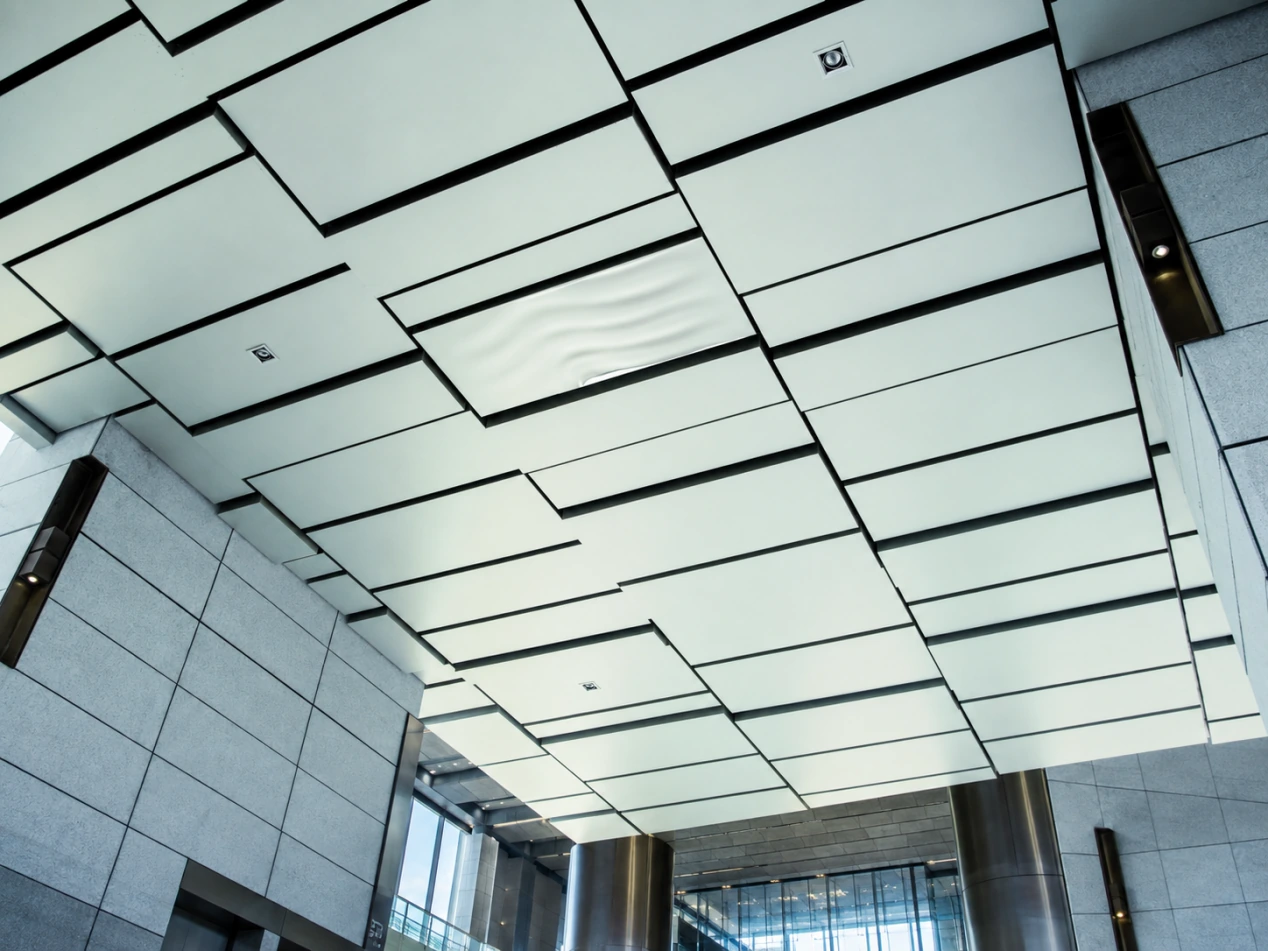
Metal ceiling panel warping usually begins with uneven residual stress, unsuitable panel geometry, poor storage, a distorted suspension system, or forced installation. Oil canning in aluminum panels is different: it is a visible waviness in broad, relatively flat areas, often made more noticeable by gloss finishes and low-angle light. A ceiling can be securely installed and still look uneven, so the first job is to identify the defect before deciding who should correct it.
The diagnosis should follow the panel from fabrication to final alignment. Check a loose panel on a verified flat surface, then inspect the carrier plane, perimeter details, service openings, and lighting direction. This separates a product-shape issue from a system issue and prevents undamaged panels from being replaced without solving the actual cause.
How Can You Tell Warping from Oil Canning?
Several distortions can produce similar shadows from floor level. Their position, repeat pattern, and behavior after removal provide useful clues.
What Does True Panel Warping Look Like?
Warping is a stable departure from the intended plane. A corner may lift, two opposite corners may rock, or the panel may twist along its length. Bowing is usually a smooth curve across the face or edge. Once the panel is removed and laid without restraint, the shape remains visible. Repeated distortion in panels from the same pack may point to forming stress, stacking pressure, or transport damage.
This is the condition most people mean by warped ceiling tiles. The term should still be recorded more precisely during inspection: corner lift, longitudinal bow, transverse bow, twist, or edge deformation. A photograph with a straightedge and a scale is far more useful than a general complaint that the ceiling “looks wavy.”
Why Does Oil Canning Move with the Light?
Oil canning in aluminum panels appears as shallow waves across the flat field. The pattern can seem stronger or weaker as the viewing position changes. Directional light grazing a smooth surface exaggerates tiny slope changes, especially on large modules, dark colors, and higher-gloss coatings. This visual effect does not automatically mean the panel has lost structural capacity.
The surface should be reviewed under the project’s normal lighting and from the agreed inspection distance. Temporary work lights placed close to the ceiling can create an unrealistically severe appearance. Even so, lighting should not be used to dismiss a real flatness problem; it is one variable in a complete assessment.
When Is the Suspension System Responsible?
A panel that looks flat when removed may distort after it is clipped, laid, or hooked into the ceiling. That points toward carrier alignment, grid squareness, perimeter compression, an incorrect hanger level, or a localized obstruction above the panel. Check several locations rather than testing only the most visible unit.
Why Can Panel Flatness Change Before Installation?
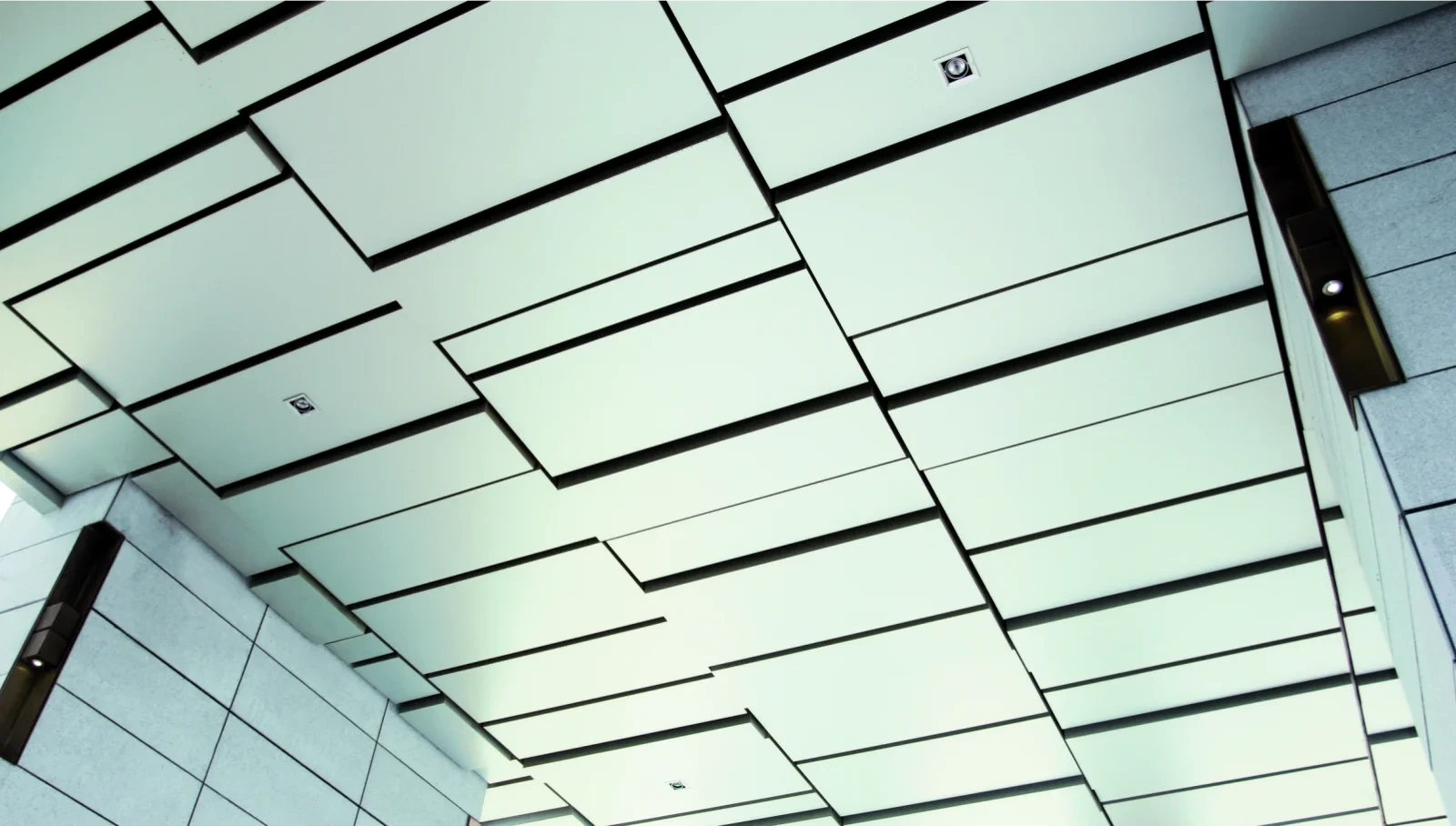
Ceiling panel flatness is influenced by material temper, thickness, module size, edge returns, perforation, forming sequence, and finish. These variables work together, so increasing one specification value cannot guarantee a flatter ceiling by itself.
How Do Size and Edge Geometry Affect Stiffness?
A larger face has more opportunity to show shallow waviness than a small face made from the same material. Folded edges, returns, notches, and reinforced zones help control geometry, but abrupt transitions can also concentrate stress. TUODELI’s metal tile ceiling range includes multiple module and installation formats, which makes the approved panel type and dimensions essential parts of a flatness review.
For a clip-in system, listed dimensions extend from 300 × 300 mm modules to larger rectangular formats, while available metal thickness depends on whether the panel is aluminum, galvanized steel, or stainless steel. Those published ranges are selection boundaries, not a rule that every size, material, and thickness combination suits every design.
Can Perforation and Coating Change the Appearance?
Perforation redistributes material across the panel face and introduces another forming operation. Hole pattern, border width, acoustic tissue, and edge details should therefore be evaluated as one panel design. A plain face and a perforated face of the same nominal size may react differently during fabrication and handling.
Finishes also alter what the eye detects. Smooth dark coatings reflect highlights sharply, while textured or low-sheen surfaces tend to soften them. Powder coating, spray paint, roller coating, anodized finishes, wood-look finishes, and stone-look finishes each have their own visual character. A full-size sample under the intended light is more informative than a small color chip.
What Happens During Packing and Storage?
Long panels stored on uneven supports can develop a set. Heavy cartons placed on one end of a stack can load the corners. Moisture-damaged packaging may lose its ability to distribute weight, while dragging one coated panel across another can mark the face before installation begins.
Keep cartons dry, level, and fully supported. Follow the marked stacking orientation, limit stack height to the supplier’s instructions, and move long units with enough people to prevent sagging. Open only the quantity needed for the active area. These simple controls reduce both warped ceiling tiles and finish damage that later resembles distortion under strong light.
Which Installation Conditions Create a Wavy Ceiling?
Manufactured panels depend on the supporting system to establish a consistent plane. Small errors in the suspension become visible when repeated across a large field.
Is the Grid Flat, Square, and Correctly Spaced?
Check hanger elevations, carrier spacing, splice locations, grid squareness, and perimeter support before loading the ceiling. A carrier that changes level at a splice can create a line of tilted panels. An out-of-square field may force the last row into openings that are too tight, transferring pressure backward through several modules.
Panels should seat with their intended clips or edges engaged. Using force to close a gap can bend a return or preload the face. The clip-in tile dimensions and finish options should be matched to the specified carrier and project drawings rather than mixed with visually similar parts from another system.
Are Perimeters and Services Loading the Panels?
At walls, the ceiling needs the specified clearance, trim, and restraint detail. A field squeezed between rigid perimeters has little room to accommodate construction tolerances or thermal movement. Conversely, an unsupported cut panel can sag or rotate.
Lights, speakers, diffusers, access hatches, and signs need independent support where required. A ceiling panel should not carry service weight unless the tested assembly and project detail explicitly allow it. Poorly centered cut-outs can also leave a narrow strip of metal that distorts during installation.
The costliest errors often occur when ceiling and service coordination starts after material reaches the site. A practical review of metal ceiling installation mistakes that increase project cost helps teams check sequencing, handling, and interface details before closing the ceiling.
How Should a Flatness Complaint Be Inspected?
A controlled inspection should separate panel condition, installation condition, and visual conditions. Use the same sequence across the affected area so one observation can be compared with another.
What Evidence Should Be Recorded First?
Begin with a marked reflected ceiling plan. Record room, grid line, panel batch, module size, material, finish, lighting condition, and viewing direction. Photograph the overall ceiling, then the affected panel with a straightedge. Do not press the face flat for the photograph.
What Does a Panel-Position Swap Reveal?
Remove one affected panel and one visually acceptable panel from the same area. Place each on a clean, verified flat surface and compare corner contact, edge line, and face waviness. Then swap their ceiling positions.
If the appearance follows the panel, panel geometry or handling is likely involved. If the appearance stays at the location, investigate the suspension, perimeter, or service interface.
Why Does the Repeat Pattern Matter?
One damaged unit near an access route suggests handling. A complete row may follow a carrier splice or level change. A perimeter band may indicate tight cuts. Similar waviness across broad, smooth faces may be an oil-canning condition amplified by lighting.
Acceptance criteria should come from the project specification, approved sample, mock-up, manufacturer tolerances, and applicable contract documents. Where appearance is critical, establish the viewing distance, lighting state, and sample approval before production.
When Should Panels Be Adjusted or Replaced?
The remedy should follow the diagnosis. Adjustment, replacement, and technical review apply to different conditions and should not be treated as interchangeable responses.
When Can Adjustment Restore the Ceiling Plane?
Adjustment makes sense when a flat panel is being distorted by an incorrect grid level, a tight perimeter, a misaligned carrier, or an obstruction. Correct the support condition first, reinstall the panel without force, and inspect the surrounding field. Replacing panels before realigning the system usually produces the same visual defect again.
Which Damage Normally Requires Replacement?
Replacement is more appropriate when a removed panel retains excessive twist or bow, has a creased return, carries permanent impact damage, or no longer engages safely. Surface refinishing on site rarely restores the original factory appearance.
Separate rejected pieces by batch and location so the review can determine whether the issue is isolated or systematic.
What Should Be Included in a Technical Review?
For unresolved metal ceiling panel warping, prepare the panel dimensions, material, thickness, finish, reflected ceiling drawings, batch labels, and photographs. Complete information allows the panel and suspension conditions to be considered together.
Ready to determine whether the problem comes from the panel, grid, perimeter, or installation sequence? Send the project details and request a metal ceiling flatness assessment before approving replacement quantities or corrective work.
Conclusion
Metal ceiling panel warping is easiest to solve when the shape, location, and repeat pattern are documented before remedial work starts. A panel that stays distorted on a flat surface requires a different response from a flat panel forced by the grid. Oil canning in aluminum panels also needs its own assessment because finish, module size, viewing angle, and light can intensify shallow waviness.
Protecting ceiling panel flatness begins with a coordinated specification, continues through forming and level storage, and finishes with an aligned suspension system and careful service integration. Diagnose first, correct the cause, and replace only the panels that remain permanently damaged or fall outside the agreed acceptance criteria.
FAQs
Q1: Can oil canning in aluminum panels be eliminated completely?
A1: It can often be reduced through suitable alloy and temper, panel proportions, edge design, forming control, finish choice, careful handling, and realistic lighting review. Complete elimination cannot be promised for every broad, flat metal surface. A full-size approved mock-up is the best way to establish the expected appearance.
Q2: Why do warped ceiling tiles sometimes look flat after removal?
A2: The supporting grid, tight perimeter, misaligned clip, or an above-ceiling obstruction may be forcing the panel out of plane. If the panel relaxes on a flat surface, inspect and correct the installation condition before considering replacement.
Q3: Does a thicker panel always improve ceiling panel flatness?
A3: Thickness can increase stiffness, but flatness also depends on material properties, module size, edge returns, perforation, forming stress, finish, storage, and support spacing. The full panel-and-grid design should be reviewed rather than changing thickness in isolation.
Other News