
Fire Ratings of Aluminum Customized Baffle Ceiling Systems Explained

A ceiling is often noticed after the floor, walls, and lighting. Yet in an airport hall, hotel corridor, school, office lobby, or shopping center, it sits above every person using the space. That is why ceiling fire safety is now a real design topic.
Baffle ceilings are popular because they create a clean linear look without closing the whole ceiling. They can hide services, guide sightlines, and make a large room feel more ordered. But when a ceiling becomes a major visible surface, its fire behavior matters. A fire-rated baffle ceiling helps project teams balance design, approval, and daily safety. For buyers, an aluminum baffle ceiling is often practical because it combines metal strength, flexible sizing, and tested surface burning performance.
Why Fire Ratings Matter in Ceiling Design
Interior ceilings can affect how a fire grows across a room. Poorly selected decorative finishes may increase flame spread or smoke, especially in public spaces with high foot traffic. A fire-resistant ceiling material cannot replace sprinklers, alarms, smoke control, or safe exit routes. It can, however, reduce the risk of using a weak ceiling finish.
Architects and contractors often ask for metal ceiling fire rating data before approval. A rating gives the team a shared technical language. Instead of relying on words like “safe” or “premium,” they can review flame spread, smoke data, and material details.
What a Class A Fire Rating Really Means
A Class A fire rating is commonly linked with ASTM E84, which measures surface burning characteristics. The test reports Flame Spread Index and Smoke Developed Index. In common classification, Class A means flame spread 0–25 and smoke developed 0–450.
Class A Is a Surface Burning Rating
A class a fire rating does not mean a ceiling is fireproof. It means the tested surface has a low flame spread classification. This is useful for interior finishes, including a fire-rated baffle ceiling, because the ceiling may cover a wide occupied area.
For an aluminum baffle ceiling, Class A performance supports safer specification in offices, retail stores, transport buildings, and public interiors. It helps reduce one concern: whether the ceiling finish could help flame move quickly across the upper part of a room.
Fire Rating Is Different from Fire Resistance
The term fire-resistant ceiling is often used too broadly. Surface fire rating and fire resistance answer different questions. Surface rating asks how flame and smoke behave on the finish. Fire resistance asks how long a full assembly can continue working during a fire.
Most baffle ceiling systems are interior finishes, not structural fire barriers. They should not be treated like rated walls or floors unless a full tested assembly proves that function.
Why Aluminum Is Suitable for Baffle Ceiling Systems
Aluminum is widely used in modern ceiling systems because it is light, formable, stable, and easy to finish. In baffle ceiling work, the blades repeat across large areas, so shape, color, and alignment matter.
A Metal Base for Safer Material Selection
Compared with many decorative boards or plastic-based finishes, an aluminum baffle ceiling gives the project a metal base. That matters when ceiling fire safety, service life, and maintenance are all part of the decision. Coatings and accessories still need review.
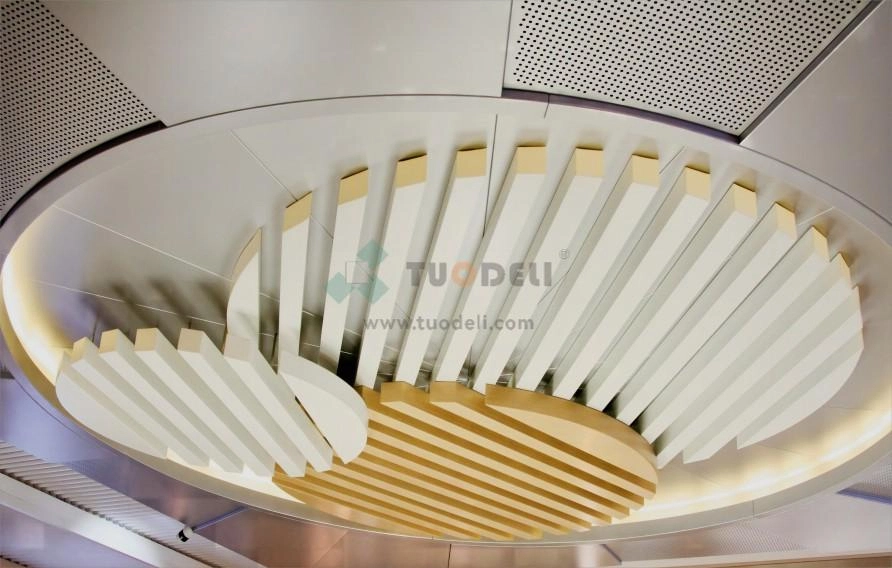
TUODELI’s Aluminum Customized Baffle Ceiling uses aluminum as the raw material. The product allows customized width and height, length up to 7000 mm, and aluminum thickness from 1.50–5.00 mm. These numbers help designers match ceiling height, blade depth, and visual rhythm while staying within the metal ceiling category.
Open Linear Design with Service Access
A custom baffle ceiling is not a closed flat panel. Its open blade layout can allow air movement, lighting integration, speaker placement, and easier access to pipes or cables above. That can be useful in offices, shopping centers, airports, stations, and other large interiors.
The open design still needs coordination. Sprinklers, smoke detectors, air returns, lights, and signage should not be blocked by baffle spacing or blade height.
Product Factors That Affect Metal Ceiling Fire Rating
A single rating is important, but it is not the whole specification. A fire-rated baffle ceiling should be reviewed as a product system. Material, thickness, finish, perforation, backing material, carrier system, and installation method may all affect approval or project performance.
Key details to check include:
· Material: aluminum for a stable metal ceiling base.
· Thickness: 1.50–5.00 mm for different blade sizes.
· Length: up to 7000 mm to reduce extra joints.
· Surface: plain or perforated options.
· Finish: powder coating, spray paint, wood-look, or stone-look coating.
· Acoustic value: perforated designs can reach NRC 0.55–0.70.
· Fire rating: ASTM E84 Class A for interior finish selection.
These details matter because baffle ceilings often sit in visible, high-value areas. A long ceiling blade may look simple on a drawing, but its thickness, hanger spacing, edge quality, and finish can affect both safety review and final appearance.
How Customization Supports Ceiling Fire Safety
Customization is not only an aesthetic feature. It helps the ceiling fit the building instead of forcing the building to fit a standard product. For a fire-rated baffle ceiling, this supports room height, service zones, lighting, and fire protection planning.
Blade Size, Spacing, and Layout
Blade width, height, and spacing shape how an aluminum baffle ceiling looks and works. Taller blades create a stronger linear effect. Wider spacing can make the ceiling feel lighter and allow easier access.
These choices should be reviewed with fire protection layouts. If the baffles sit too close to sprinklers or detectors, they may create site conflicts. A safer custom baffle ceiling starts with drawings, not guesswork.
Surface Finish and Acoustic Needs
Surface finish affects color, texture, cleaning, and brand image. Powder coating and spray paint are common choices. Wood-look and stone-look coatings can add warmth while keeping the aluminum base.
Perforation adds another layer. It can support acoustic comfort, with TUODELI’s perforated option showing NRC 0.55–0.70. For public buildings, coating, perforation, and acoustic backing should be checked together with the required metal ceiling fire rating.
Where Fire-Rated Aluminum Baffle Ceilings Work Well
A fire-rated baffle ceiling is useful where the ceiling must look refined and work reliably. Office lobbies need a clean first impression. Retail spaces need clear visual direction. Airports and stations need open ceilings for large areas. Hotels and public corridors need finishes suitable for repeated use.
In these spaces, ceiling fire safety is part of trust. The ceiling may be above hundreds or thousands of people each week. Choosing an aluminum baffle ceiling with a class a fire rating helps show that design and safety have been considered together.
Why Choose TUODELI for Aluminum Customized Baffle Ceiling
TUODELI provides Aluminum Customized Baffle Ceiling systems for projects that need design flexibility, metal material performance, and specification support. The product combines customized width and height, plain or perforated surfaces, several finish choices, acoustic options, and ASTM E84 Class A fire rating.
This makes it a suitable option for buyers who want a custom baffle ceiling without moving into uncertain decorative materials. For offices, retail interiors, transport spaces, and public buildings, TUODELI’s aluminum baffle ceiling can help create a modern ceiling while keeping fire-rated material selection in the plan.
Conclusion
A fire-rated baffle ceiling helps commercial interiors combine modern design with safer material selection. Class A fire rating data explains surface burning behavior, while aluminum brings a stable metal base, long service life, and flexible appearance. The best result comes from matching rating, coating, blade size, spacing, acoustic needs, and site systems before production starts. TUODELI’s aluminum baffle ceiling offers a practical choice for projects that need custom design, ASTM E84 Class A performance, and clean visual impact. Project teams can contact TUODELI for dimensions, finishes, drawings, and project documents.
FAQs
Q: What is a fire-rated baffle ceiling?
A: It is a baffle ceiling with tested surface burning performance for safer interior finish selection.
Q: Does Class A fire rating mean fireproof?
A: No. Class A measures flame spread and smoke, not full fire resistance.
Q: Why choose an aluminum baffle ceiling?
A: It offers metal durability, custom design, and strong ceiling fire safety support.


